De-Icing & Road Salt (Winter Road Safety Grade)

Reliable Himalayan Rock Salt for Ice Control, Winter Road Maintenance & Surface Safety 

Winter conditions disrupt transportation, slow logistics, and impact national economies. Snow, black ice, and frozen surfaces increase accidents, block mobility, and raise fuel consumption — especially for transportation and supply-chain fleets. De-icing salt plays a critical role in keeping roads functional, safe, and economically stable during harsh winter conditions. 

Our Himalayan De-Icing Salt is sourced from ancient rock salt deposits, naturally durable and mechanically processed to ensure consistent particle size and reliable winter performance. Used by municipalities, contractors, highway authorities, and industrial operators, it is an essential mineral resource for large-scale winter maintenance. 

How De-Icing Salt Works

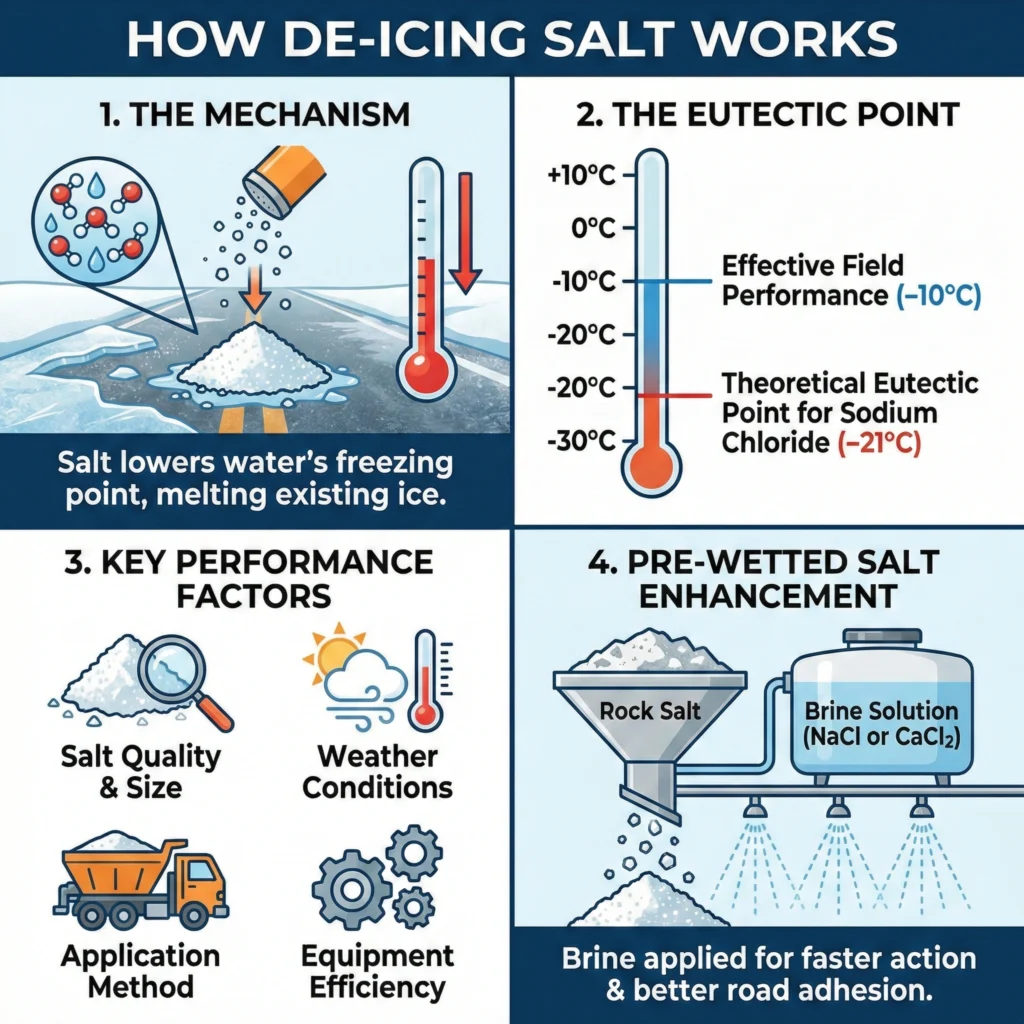
De-icing salt lowers the freezing point of water, helping to melt existing ice and prevent new ice formation. 
The eutectic point (the lowest temperature at which salt can melt ice) for sodium chloride is approximately –21°C, though most effective field performance is typically observed down to around –10°C, depending on environmental conditions. 

Key Factors Affecting Performance: 
• Salt quality & granule size 
• Weather conditions (humidity, air temperature, wind) 
• Application method (raw, treated, or pre-wetted) 
• Spreading equipment efficiency 

Pre-wetted rock salt — a common enhancement method — uses a brine solution (sodium chloride or calcium chloride) applied to the salt before spreading to encourage faster action and improved road adhesion. 

Economic Importance of De-Icing Salt

Transportation is the backbone of every economy. Research from the UK suggests that every pound spent on effective de-icing may return up to eight pounds in economic savings through:

  • Reduced accidents
  • Fewer road closures
  • Lower vehicle delays
  • Lower fuel consumption
  • Sustained business continuity 

These estimates do not include the reduction in human injury, property damage, or emergency costs — further supporting the vital role of reliable road maintenance practices. 


Technical Specifications (Typical Range)

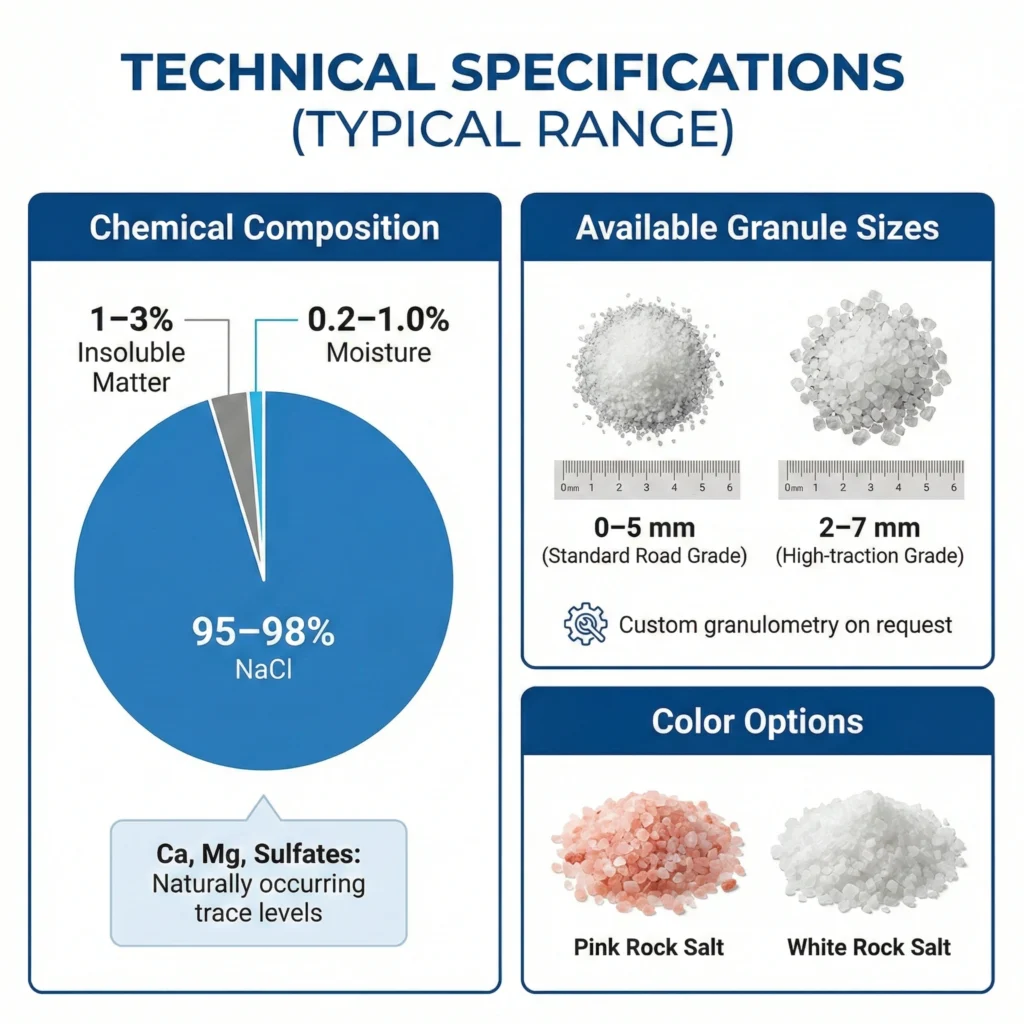
Chemical Composition: 
• NaCl: 95% – 98% 
• Moisture: 0.2% – 1.0% 
• Insoluble Matter: 1% – 3% 
• Ca, Mg, Sulfates: Naturally occurring trace levels 

Available Granule Sizes: 
• 0–5 mm (Standard Road Grade) 
• 2–7 mm (High-traction Grade) 
• Custom granulometry on request 

Color Options: 
• Pink Rock Salt 
• White Rock Salt 

Applications

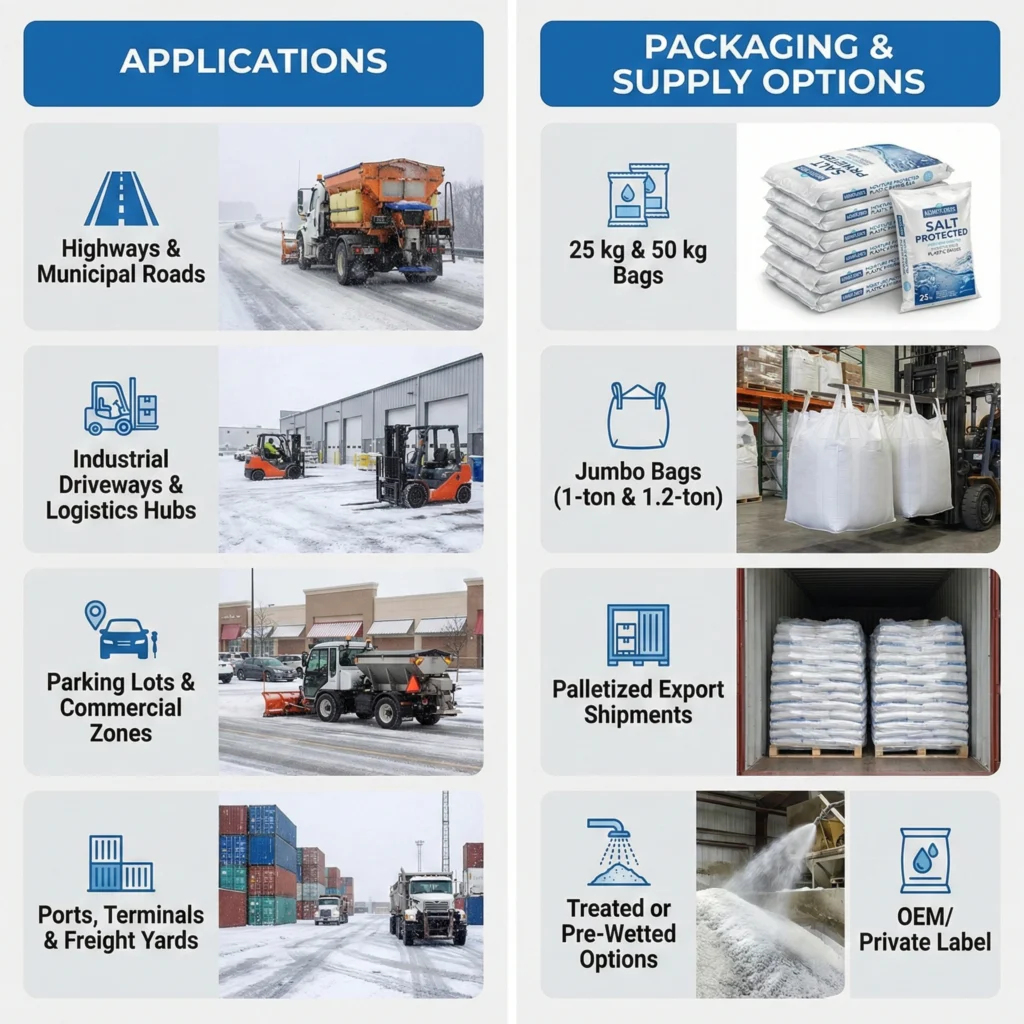
• Highways & municipal roads 
• Industrial driveways & logistics hubs 
• Airport service areas (non-runway) 
• Parking lots & commercial zones 
• Private contractors for winter maintenance 
• Ports, terminals & freight yards 

Packaging & Supply Options

• 25 kg & 50 kg moisture-protected bags
• Jumbo Bags (1-ton & 1.2-ton)
• Palletized export shipments 
• Treated or pre-wetted options available on request 
• OEM/private label programs for distributors